All posts by localsplashdev

Do you know what Wolfram Alpha is? Don’t worry if you answered “no”, you are far from alone. With the tag line “Computational Knowledge Engine”, its not a product that has been positioned for the masses. That changed a a year and a half ago when Apple introduced Siri. The reason is Wolfram Alpha powers a huge segment of what Siri does. Specifically, it is responsible for answering most of the general knowledge questions you ask her/it. For instance, if you ask Siri what the average snowfall is in Flagstaff, Arizona Wolfram Alpha processes your questions and gives the correct answers. It accomplishes this by gathering information from hundreds of thousands of data points — from weather to mathematical proofs and major/minor pentatonic scales. This is where the “Knowledge Engine” part comes from. Unlike Google it doesn’t search for things, it “knows” things and figures out the correct answer to gives you. This process is generally referred to as semantic search because it is based on understanding your search intent and the meaning of terms based on context and the words used, as opposed to looking for the exact verbiage used in a search query and providing matches.

Now you may be wondering, “Dan what does this have to do with web marketing?”, and I’m glad you asked. Lots of people own iPhones. And as Google has been telling us for a while, over 50% of mobile searches have local intent. Since Apple has over 50% of the mobile market share that means that a significant number of mobile searchers have access to Siri. Even if only a fraction of those people are using Siri for search it is still a channel that should be optimized. But besides that, Apple has a large foot in the door of semantic search, which is something Google wants.

What does all this mean?

It means a change in what SEO even is. In the case of Google’s current attempt at semantic search, Knowledge Graph, the information requested in a search query is able to be displayed by Google itself in SERPs rather than displaying pages with relevant data and expecting you to click on them. This is a big change from the document retrieval model of search that we have all grown accustomed to for the past 10+ years. Don’t worry though, there are still tactics and techniques you can use to make sure you aren’t left out in the proverbial cold. This SEOmoz article is an excellent beginning point. The most important thing to remember is that you shouldn’t panic because full-fledged semantic search is still off in the future, and while it is always prudent to future proof your business (and your web marketing) the world isn’t quite changing just yet.


Foursquare Updates

Foursquare has grown substantially, since its inception in 2009. Designers and developers have continually enhanced the mobile app features to provide a better user experience.

Foursquare Recent Check-ins

Below are just a few of the changes that have affected local SEO strategies in regards to Foursquare:

1. Included an Interactive map and adding more search categories
2. Introduced a new rating system for venues
3. Introduced “Foursquare for Business” app
7. Included larger, highlighted location photos
8. Added more recommendations to the Explore tab
9. Introduced the suggested nearby places map
10. Has an algorithm that not only considers what is nearby, but what is similar to what you have already searched.

The above indicate that Foursquare is gradually moving away from its original focus on gamification, and is looking to improve search and recommendation features with their app.

Foursquare considered reasons people use their mobile app. Even though every feature adds to a more enhanced user experience, there is a progression that most users take when moving through the site.

Foursquare wanted to provide a more direct way to navigate to the areas that are most popular with their users. Users don’t usually want to see random places their friends have visited, but specific, local places. Therefore, exploring nearby places should be the focus.

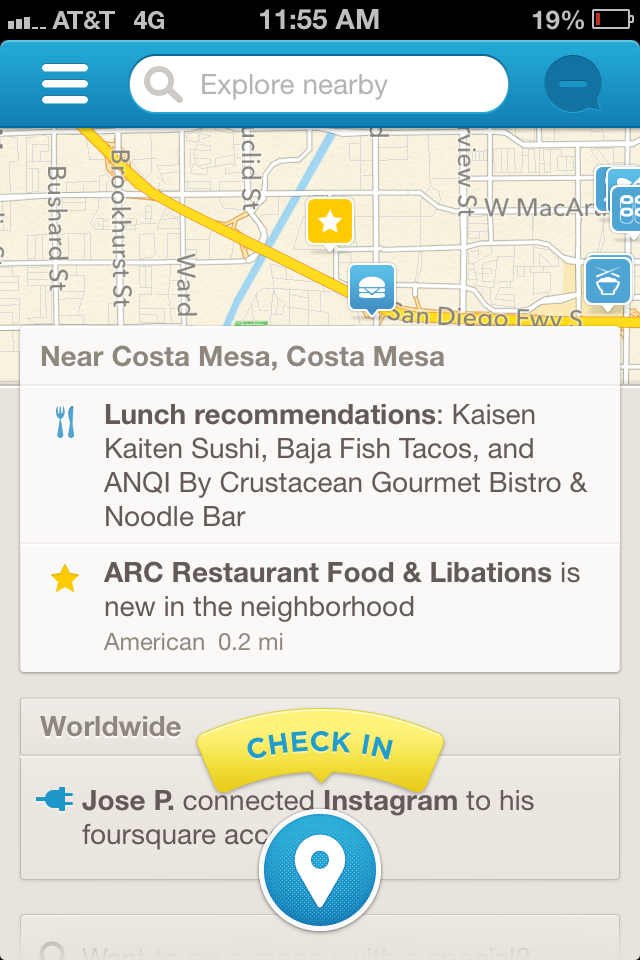
Foursquare introduced another change Wednesday, April 10th to iOs. It made the “Explore Nearby” search area the first thing you see on the home screen, rather than your friend’s check-ins, when you log on.

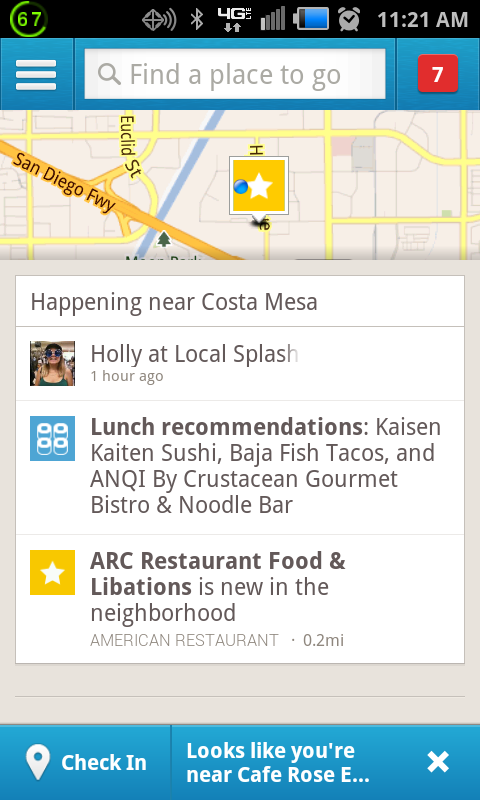
Android users have a similar home screen look, but there are still some differences (e.g., the suggested text in search bar) between what Android users see and what iOS users see. One can compare home screens for Android (left) vs. iOS (right) by viewing the two screenshots below:

Foursquare Home Screen on Android

Foursquare Home screen on iOS


What do these changes mean for the local search professionals?

Foursquare can now compete on a level with Google Plus Local and Yelp. Relying heavily on check-ins was not the best route to go when shifting to more of a local search focus, similar to their competitors.

Now, recommendations based on current time and location are presented even before reaching the check-in button. Businesses have a better chance of catching a potential customer’s eye.

Foursquare has been on many local search professionals’ radar. With the most recent change, though, Foursquare is positioned to become even more important to local SEO’s. It is time to think about optimizing businesses so they can become one of the “trending” or “suggested” businesses for a particular area on Foursquare.

The Explore feature, in itself, isn’t new, but placing it at the forefront means local search gurus will want to incorporate it within their local search strategies. Below are some recommended articles and/or posts for exploring this topic further:

1. 10 Reasons To Use Foursquare Explore For Personalized Local Searches
2. Is Foursquare the Latest Dark Horse in the Local Search Race?
3. Foursquare Explore: Search, Social, and the Real World

Maintaining high placement on major search engines is a constant struggle on an ever-changing playing field. Luckily, there are many paths to choose from when trying to get your site to the top of the list. Of the myriad options available to the potential SEO enthusiast, one of the most obvious paths to pursue is to create an effective video campaign.

Is It Better To Burn Out Or Fade Away?

There are several questions to consider when launching your video campaign, not the least of which should be where to host them. The first thought on nearly everyone’s mind should be YouTube. 72 hours of footage are uploaded to YouTube every minute, and much of it will never cast more than a few views’ worth of dim glow over the dull and glassy eyes of your average web surfer. Of course, there are a few elite videos that attain the coveted “viral” status, spreading across the internet like wildfire, racking up millions of views and, in some cases, refusing to relinquish their place in your head once they’re there.

I’ll just watch Gangnam Style one more time…just one more time…

Can A Viral Video Take My Business To The Top?

Viral videos have notable benefits over other video strategies. For starters, viral videos spread across large audiences at an exponential rate, putting your name in the minds and on the lips of viewers and spreading by word of mouth very quickly. Creating a viral video usually costs less than other video strategies, and since it relies on being entertaining enough to grab a viewer’s attention and keep them watching, a viral video is usually a real pleasure to watch.

We can all learn something from this man.

It’s easy to think that if you can get just one viral video, it will be all you will ever need. Unfortunately, it usually isn’t that simple. Going viral worked for PSY, but for most brick and mortar businesses, viral videos are risky ventures. A viral video isn’t guaranteed to increase sales and since the odds are against a video going viral, relying on viral videos to promote your business isn’t a sustainable approach. Don’t get me wrong; a viral video can be very beneficial for a business, but there are more reliable options out there. 

So What Does That Leave Me? 

Most successful video strategies are built on the backs of more than just one video. They’re steadily constructed out of multiple high-quality posts that promote brand awareness- much like a blog. A video strategy comprised of several different types of content, compiled in a well-managed and regularly updated channel, will take you much farther than a single high-view viral sensation.

In addition to regularly posting high-quality videos,  it’s important to make sure your YouTube channel is properly organized. For instance, a series of tutorials on how to effectively use your product or troubleshooting steps to follow when a product fails to function properly is a solid choice for a well-rounded video campaign. However, if your channel is disorganized and hard to navigate, your clients are less likely to find the right video when they need it.

Though the allure of several million YouTube views is tempting, it’s important to remember that statistically, you have a better chance of winning the lottery than having your video go viral. While that might be a humbling thought, just try to keep in mind that anything worth having is worth putting the effort into getting, and, like the old fable, you’ve got a better chance of winning the race with a slower, steadier approach.