

As we all know, change is inevitable and in order to keep up with it, we need to update. When you think about it, you probably update everything from your Facebook profile to your wardrobe on a monthly basis at the very least. So why do you fall short when it comes to making sure your business listings stay updated?

It is a common belief that once your business is listed with Core Data Providers (CDPs), that the database will automatically find and update your information when it changes. This is both true and false. Yes, CDPs will find your new business information and add it to their records. However, they often do not remove the old information and leave the outdated business address, phone number, business name, website, email address, product and service offering or owner name. This is because CDPs are in the business to sell a lot of leads. They makes more money by having more records available, even if they are duplicate records. For this reason CDPs do not make an effort to delete old information. Top directories then buy business information from CDPs that they then turn into listings. If there are two different sets of information for one business in the CDPs database, they will often take both.

As a result, you will have two different business listings in directories like Google, Yahoo!, Yelp and Merchant Circle; one with the correct information and one with the old, incorrect information. You can understand how this could get confusing for potential customers trying to find your business as well as search engines who are trying to index your information. This is why having duplicate or inconsistent business information will hurt your search engine rankings.

Another problem with only having your business information listed with CDPs is the update frequency of your listings. Top directories rely on CDPs to provide them with business listings, however many of them do not ever go back once they’ve used CDPs and they do not update automatically. This means that updated listings will not be found in directories like Google and Yahoo! unless someone manually goes to each directory to update the listing. Odds are if you changed addresses or phone numbers, unless you or your Internet marketing company have done something about it, your listing will be incorrect in Google Maps. This incorrect information will hurt your rankings, reputation and chances of attracting new customers.

Verification is another thing you need to think about when submitting your business information to directories. In many cases, just because you submit your information, doesn’t mean the directory will turn it into a listing. Directories often have moderators that decide whether the information is made into a listing and the time it takes for this decision to be made could be months. By the time your listing is approved or rejected, you could have forgotten you even submitted it. If it is rejected, you’re not helping your link building efforts or your ranking.

Some directories such as Google require a verification code to ensure that the information being submitted is correct and the owner is really the person “claiming” the business. CDPs have few methods to produce precise verification, which is one of the reasons why they contain misinformation.

Local Splash submits business information on behalf of their clients to a variety of top directories such as Google Places, Yahoo!, Relevant Yellow, Yelp, Facebook, Merchant Circle, SuperPages.com, RateItAll, YellowBot, Clush, Oodle, AboutUs, Vast and Acxiom. Then the company provides “permalinks” to prove that your business has been submitted and accepted to directories. Local Splash maintains a direct relationship with top directories in order to get its clients approved faster. This means clients will be able to climb the Google rankings quickly which will help get them leads and sales within a few weeks. Using the Local Splash Back Office platform, clients can log in and see all of their placements in one location online. CDPs do not provide this kind of service.

Local Splash also “cleans up” inconsistent data for clients. This means getting rid of duplicate listings, correcting misinformation and making sure all inconsistent data is fixed. One of the main downfalls of CDPs is that they do not do this.

It’s important to remember that updated listings are key for good rankings. CDPs may help get your business name out on the Internet but they help get misinformation, inconsistent data and duplicate listings online in the process. Working with an expert local SEO company like Local Splash will help get your correct business information submitted to multiple directories as well as your misinformation cleaned up. Without this service, getting to the top of the Google rankings is much tougher and takes much longer.
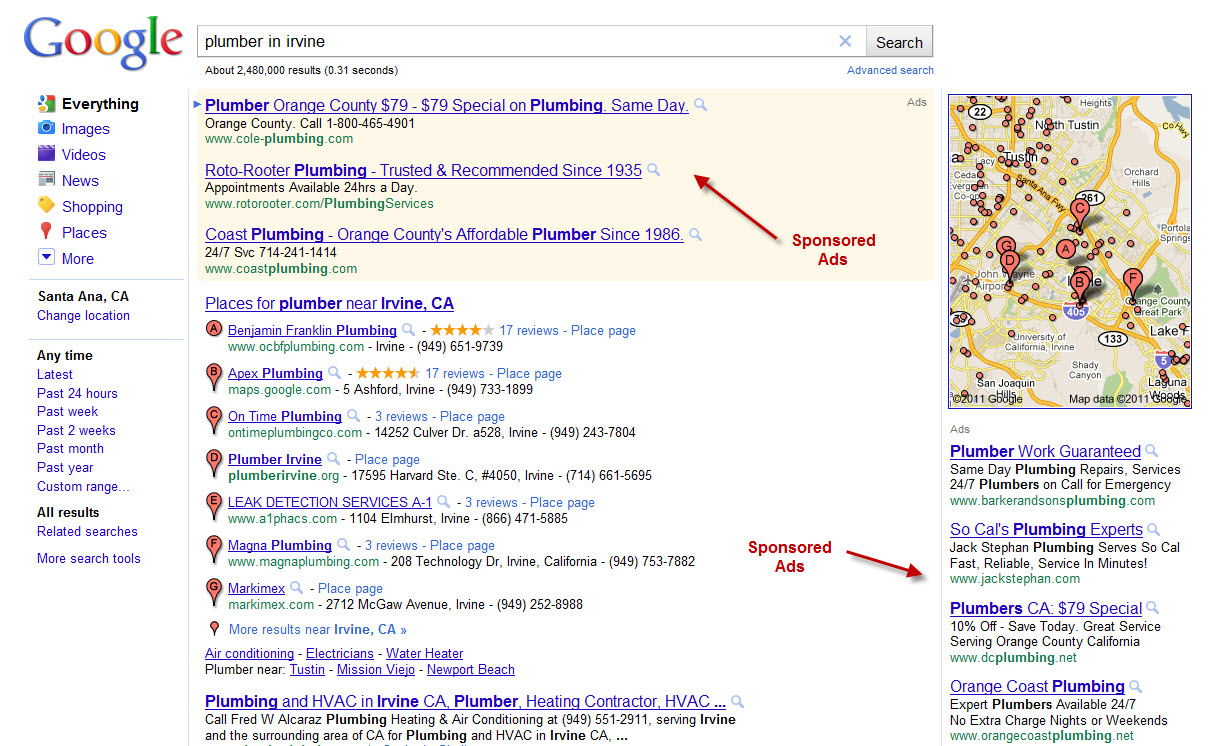
Google Ads is a service that allows users to create and run pay-per-click ads for their business. Pay-per-click (PPC) means just that, that you only pay for the ad when someone clicks on it. These ads are displayed along with the search results when someone searches Google using one of your keywords. The ad will appear under “Sponsored links” in either the side column of the results page or the top row above the free search results.

The main advantage of Google Ads is that since you choose relevant keywords for your ad, it allows you to advertise to an audience that’s already interested in your business. When potential customers search for your keywords on Google, your sponsored ad will appear above or next to the natural search result (see image). With Google Ads, you get the freedom of choosing from multiple ad formats that can include text, images and videos.

SponsoredAdsScreenshot

This is what Google Sponsored Ads look like on the search results page.

PPC marketing is especially valuable to those local businesses who are in very competitive industries or industries where you travel to the customer rather than the customer coming to your physical location. This is because Google Maps is geo-targeted which means its hard to get exposure in a certain location without a physical address. For example, if your business is in Huntington Beach, but you would like to service customers throughout Orange County as well as Los Angeles County, the easiest way to reach your target audience would be with PPC ads. In fact the entire PPC system can be customized so ads appear exactly in the area where your target audience resides. At Local Splash, the option of PPC advertising is available to all of our clients through our premier local SEO services. We will work with you personally to target those zip codes, days of the week and time of the day you’d like your PPC ads to appear.

SoCal Map

If your business is in Orange County but you would like to service customers throughout Orange and LA Counties, PPC advertising can help.

The cost of your Google Ads PPC ads varies depending on the audience you are trying to reach and the location of your business. There’s no minimum monthly charge for Google Ads. You have full control over how much you’re willing to spend each day as well as how much you’re willing to pay per click or per impression (your ad being seen in the search results). The best part about a PPC advertising campaign is that you pay only for clicks on your ads or for impressions your ads receive.

The price per click of each ad also depends on which keywords you want to use. The more competitive keywords, or the keywords that people want to use the most cost more money per click. These are generally broad keywords; for example, “salon.” The more targeted and specific keywords tend to cost less because there is less competition for them. An example of a targeted keyword is “huntington beach salon” or “hair stylist orange county.” Being more specific when choosing your keywords is a good idea because targeted keywords convert to business and phone calls. You can use the Google Keyword Tool to view keyword traffic and cost estimates then make a decision about choosing the right keywords in order to maximize your budget.

Once you get your account set up, you can analyze your Google Ads reports to figure out which ads are working for you and which ads need to be replaced or altered. PPC campaigns are all about trial and error because what works for one business might not necessarily work for yours. If you aren’t familiar with PPC advertising, it can be complicated and in many cases it’s best to let a professional handle your campaign.

Local Splash will take care of all aspects of your paid ad campaign. Local Splash only charges a 25% fee to manage the majority of our clients PPC campaigns. Many companies may charge up to 50%. For customers who spend $500 or more on their Google Ads campaign, Local Splash charges even less for management. For example, customers that spend $1000 or larger on their PPC ads, will only be charged an 11% management fee by Local Splash.

Local Splash currently has 14 Google Ads Qualified team members who have demonstrated expert status in Google Ads by taking and passing both the Advertising Fundamentals exam and one advanced-level exam. These individuals have received a Google-branded certificate that showcases their Google Ads knowledge.

According to our Local Splash Google Ads Certified experts, any business that goes out to service their customers should definitely think about using PPC marketing to reach customers that may not be in their direct area. However, companies that have a physical business location can benefit just as much as those that don’t. This is simply because Google only allows 5 keyword categories on Google Places accounts and their Google Ads accounts allow up to 2000 keywords. The additional keywords will help your business show up for more keyword phrases, therefore increasing the chances of potential customers finding you rather than your competitors.

Are you ready to start your pay-per-click advertising campaign? Call one of our friendly customer service representatives and let one of our Google Ads experts set up a campaign that will give you the maximum bang for your buck today.

Google, along with other top search engines, is currently competing to provide you with the best local search engine possible. That’s why they’ve already gathered information on millions of local businesses – to provide you with the most relevant information possible through Google Places. Google Places is a local business directory that provides users information about local businesses such as address, phone number, description, business hours, photos, videos, reviews, driving directions and more. If your business is listed in Google Places it will also be able to show up on the Google Map, which appears at the top of the search results page and helps direct consumers right to your business location.

Odds are, if you’re not a new business, your company already has a Google Places listing. So you may be asking, “if my company is already listed, why do I need to bother with ‘claiming’ my listing?”

Although Google may already have your business in its database, the information it has may not be correct and it is certainly not optimized. Google and other search engines often obtain incorrect or outdated information that can really put a damper on your rankings. Sometimes duplicate listings are made by mistake, which doesn’t only confuse your potential customers but also the search engines, which penalize you with lower rankings.

Claiming your business has many advantages. Here are the top 3 reasons why you should claim your business on Google Places:

1. You can update your information easily when needed – Once your local business information is on Google Places, Google is not going to update it. This means that there could be misinformation about your business on your listing as well as outdated information. Claiming your business allows you to edit this information as needed, giving you full control over your business’s image.

2. Optimizing your local listing is an option – Once you claim your listing, you will be able to optimize it using keywords and categories to help it get to the top of the Maps. Listings that haven’t been claimed have little or no local SEO, so claiming your listing and adding more information will make it complete and give you an advantage over your competitors.

3. Adding enhancements – Once you claim your Google listing, you can add enhancements that make your listing more appealing to the search engines and your potential customer. Adding more information such as business hours, videos, a URL to your Website, coupons, photos and more will help consumers who view your listing. These enhancements also make your listing look better to Google and you will be rewarded with higher search rankings.

Google wants businesses to claim their listing. For this reason, when a business is claimed, higher search rankings will follow. The bottom line is, if you claim your Google business listing, you will have more control over your online image, higher rankings and more consumers will be able to see your listing. This means more potential new customers leading to more profit.